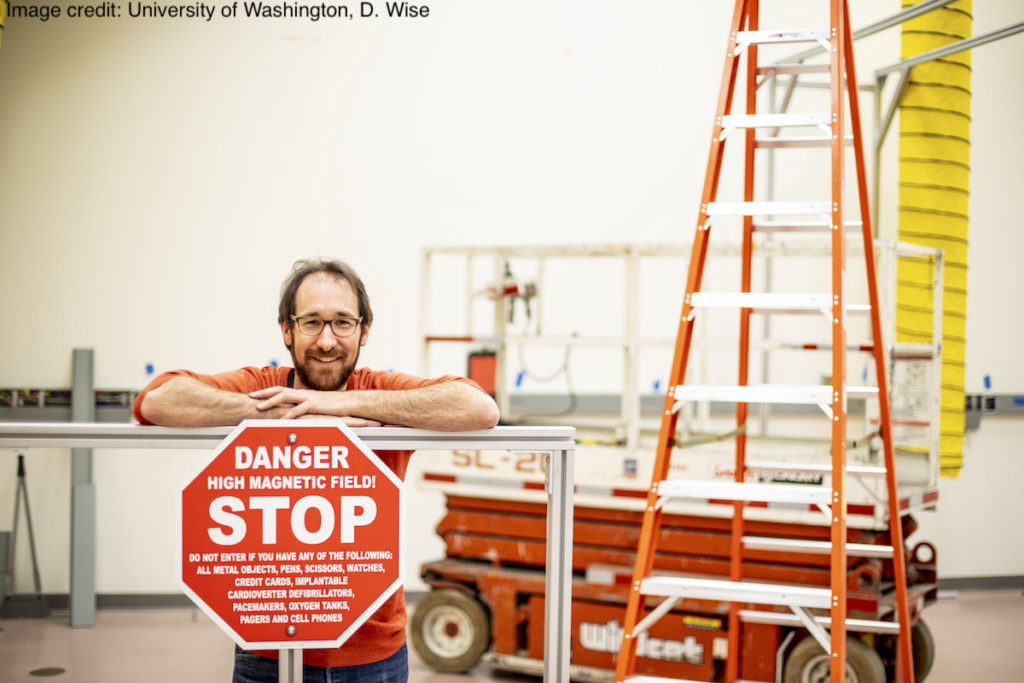
Welcome to the research group of Prof. Dr. Martin Fertl
Our research group focuses on the high-precision determination of properties of neutrons, muons and neutrinos. These elementary systems provide superb test beds for the experimental test of the predictions of the Standard Model of Particle Physics and the Standard Model of Cosmology.
Neutron lifetime
The tSPECT experiment aims at a precise determination of the lifetime of the free neutron using the double spin-flip loading method to suspend an ensemble of ultracold neutrons in a fully three-dimensional magnetic trap without material wall interactions. The experiment is currently operated at the Paul-Scherrer-Institute, Villigen, Switzerland.
Neutrino mass
The Project 8 collaboration has demonstrated the novel technique of cyclotron radiation emission spectroscopy with single electrons, which opened a new avenue in precision nuclear decay studies. Ultimately, we aim to apply this new technology to a precision determination of the decay spectrum of atomic tritium to reach a sensitivity to the effective electron neutrino mass beyond the reach of the current state-of-the-art technology. Based on a small sample of molecular tritium confined in a microwave guide, we derived the first frequency-based neutrino mass limit. Beyond the spectroscopy of keV-energy electrons for neutrino mass searches, the CES technology was expanded to the MeV-energy region for electrons and positrons.
Muon g-2
The Muon g-2 experiment has measured the anomalous magnetic moment of the muon to the unprecedented precision of 127 parts-per-billion. This presents one of the most stringent tests of the Standard Model of Particle Physics and represents the culmination of more than one decade of experimental and theoretical research by the Muon g-2 collaboration and the Muon g-2 theory initiative. While our experimental result confirms the previous experiment at much higher precision, it revealed yet to be resolved inconsistencies in the theoretical predictions of the value of muon g-2.